
Introduction
Bulk packaging plays a critical role in determining not only transportation and storage efficiency but also overall cost control and brand perception. For manufacturers, exporters, and distributors, choosing solutions such as industrial grade BOPP packaging bags alongside traditional options directly impacts product safety, logistics expenses, and long-term market positioning.
Among the most widely used bulk packaging options in India, PP woven bags and BOPP laminated bags serve very different economic purposes. While PP woven bags are valued for strength and cost efficiency, laminated BOPP woven bags bring added value through branding, presentation, and shelf appeal. Understanding when to choose each option helps businesses align packaging decisions with operational and commercial goals rather than relying on a single solution for all applications.
Understanding the Basics of PP Woven and BOPP Bags
What Are PP Woven Bags
PP woven bags are manufactured using woven polypropylene tapes that form a strong, flexible fabric structure. These bags are primarily designed to handle heavy loads and rough handling conditions, making them suitable for bulk industrial packaging.
PP woven bags are commonly used for products such as cement, fertilizers, grains, sugar, sand, chemicals, and other dry commodities. Their popularity comes from their high tensile strength, breathability options, reusability, and relatively low production cost. Depending on requirements, they can be supplied in laminated or unlaminated form, with customization in size, GSM, and printing.
From an economic standpoint, PP woven bags are favored when the priority is safe transportation of large volumes with minimal packaging cost per unit.
What Are BOPP Bags
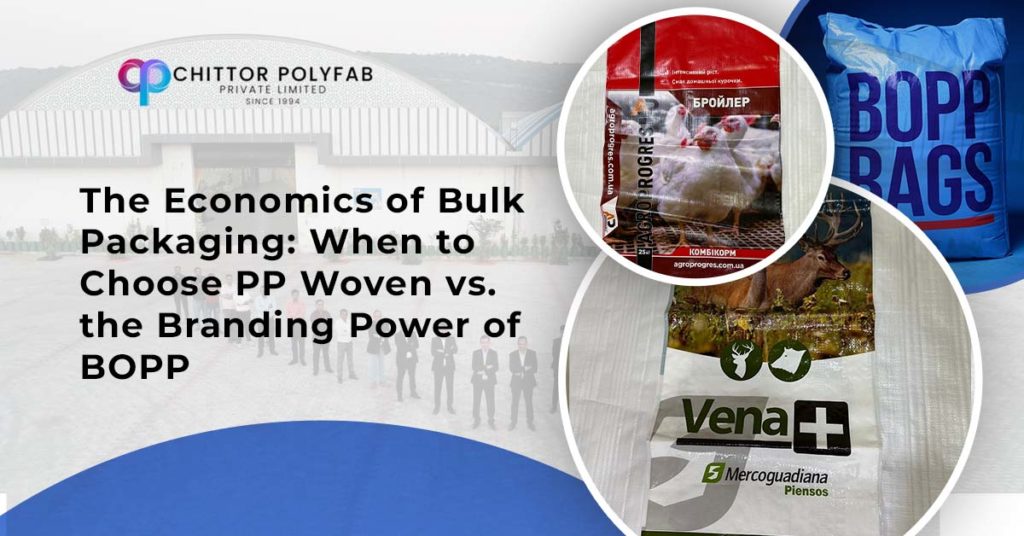
BOPP bags are a premium form of woven packaging that combine a polypropylene woven base with a laminated BOPP film layer. The BOPP film undergoes biaxial orientation, which improves strength, surface finish, moisture resistance, and print quality.
These bags are widely used in applications where visual presentation, branding, and product differentiation matter. Common uses include packaged food grains, pet food, specialty fertilizers, animal feed, and consumer oriented bulk products. The smooth surface of BOPP film allows high resolution printing, making branding more impactful at retail and distribution points.
Economically, BOPP bags involve a higher production cost compared to standard PP woven bags, but they often deliver better return on investment by improving brand visibility, reducing product damage, and supporting premium positioning.
Cost Economics: Production and Material Considerations
Raw Material Cost Differences
The base material for PP woven bags is standard polypropylene resin, which keeps raw material costs relatively stable and affordable for large scale production. This makes PP woven bags a cost effective choice for industries where packaging is a functional necessity rather than a branding tool.
BOPP bags, on the other hand, require additional BOPP film layers and specialized processing. The biaxial orientation process and film lamination increase material and processing costs. As a result, BOPP bags typically carry a higher per unit cost compared to plain PP woven sacks.
Manufacturing Process and Complexity
PP woven bags follow a simpler manufacturing process involving tape extrusion, weaving, cutting, stitching, and optional lamination. This streamlined process supports high volume production and cost control.
BOPP bags involve extra stages such as rotogravure printing, film lamination, and quality checks for surface finish and print accuracy. These added steps increase manufacturing complexity and production time, contributing to higher costs but also delivering superior aesthetics and consistency.
Cost Per Unit and Economic Impact
For businesses handling large quantities of low margin goods, even small differences in packaging cost can significantly affect profitability. PP woven bags offer a lower cost per unit and are ideal where durability and volume efficiency are the primary concerns.
BOPP bags, while more expensive per unit, can justify their cost in scenarios where branding, retail appeal, or export presentation influences purchasing decisions. In such cases, the added packaging expense can translate into higher perceived product value and improved market competitiveness.
Performance Comparison for Bulk Packaging
Strength, Durability, and Load Handling
PP woven bags are engineered to handle heavy loads and repeated handling. The woven polypropylene structure distributes weight evenly, making these bags suitable for commodities that typically range between 25 kg and 50 kg. Their resistance to tearing and seam failure makes them dependable for bulk transport across long supply chains.
BOPP bags also offer strong load handling capabilities due to the woven base fabric. However, their strength is complemented by the laminated BOPP film, which adds surface protection and improves resistance to abrasion. While both options perform well under weight, PP woven bags are generally preferred for extremely rugged environments where branding is not a priority.
Moisture and Environmental Resistance
Moisture exposure is a key factor in bulk packaging performance. Laminated PP woven bags and BOPP bags provide effective moisture barriers, protecting contents such as cement, fertilizers, and food grains from humidity.
Unlaminated PP woven bags allow airflow, which is beneficial for products that require ventilation, such as grains or agricultural produce. BOPP bags offer a sealed surface that improves moisture resistance and cleanliness, making them suitable for packaged goods that require longer shelf life and protection from environmental contaminants.
Longevity and Reusability
PP woven bags are widely reused across industries due to their durability and resistance to wear. Their ability to withstand multiple handling cycles makes them economical for businesses focused on cost efficiency.
BOPP bags, while also durable, are often reused less frequently due to branding considerations. Once printed branding becomes damaged, the bag may lose its visual value, even if structural integrity remains intact. From a purely functional standpoint, PP woven bags generally offer higher reusability for industrial operations.
Branding and Market Impact Differences
Print Quality and Shelf Appeal
One of the most significant advantages of BOPP bags is their superior print quality. The smooth laminated surface supports high resolution graphics, consistent colors, and sharp branding elements. This makes BOPP bags highly effective for products that compete on visual appeal, particularly in retail and export markets.
PP woven bags, while printable, typically use flexographic printing, which is more functional than aesthetic. Branding on PP woven bags is suitable for identification and compliance but is not designed to attract consumer attention at the shelf level.
Visual Aesthetics vs Industrial Necessity
In industrial environments, packaging is often judged on performance rather than appearance. PP woven bags fulfill this requirement by offering reliable protection at a lower cost.
In contrast, BOPP bags serve a dual purpose. They protect the product while also acting as a marketing tool. For businesses where packaging influences buyer perception, such as food grains, pet feed, or branded agricultural products, the visual advantage of BOPP bags plays a significant role in purchasing decisions.
Industry Use Cases Emphasizing Branding
Industries that sell directly to distributors, retailers, or consumers benefit more from BOPP packaging. These include packaged food, animal feed, specialty fertilizers, and consumer oriented bulk goods. In these cases, packaging contributes to brand recall and perceived quality, which can justify higher packaging costs.
Practical Decision Framework for Businesses
When to Choose PP Woven Bags
PP woven bags are the preferred choice when cost control, strength, and efficiency are the primary objectives. They are ideal for cement, construction materials, fertilizers, grains, chemicals, and other bulk commodities where packaging performance outweighs visual presentation.
These bags support automated filling systems, withstand rough handling, and minimize packaging cost per unit, making them suitable for high volume industrial operations.
When to Choose BOPP Bags
BOPP bags are better suited for applications where branding, presentation, and moisture protection are important. They are commonly used for retail oriented packaging, export shipments, and products that benefit from high quality visual identity.
Businesses looking to differentiate their products in competitive markets often select BOPP bags to enhance shelf presence and reinforce brand positioning.
Balancing Cost and Return on Investment
The choice between PP woven and BOPP bags should be guided by overall return on investment rather than upfront packaging cost alone. While PP woven bags reduce operational expenses, BOPP bags can increase product value and sales potential.
Aligning packaging selection with product type, target market, and distribution strategy ensures that packaging supports both economic efficiency and long term business growth.
Environmental and Sustainability Considerations
Sustainability has become an increasingly important factor in packaging decisions, particularly for businesses operating at scale. Both PP woven bags and BOPP bags are made from polypropylene, which is recyclable and suitable for reuse when handled properly.
PP woven bags are often reused multiple times across supply chains, especially in industrial and agricultural environments. Their longer functional life reduces the need for frequent replacement, helping lower material consumption over time. This makes them a practical choice for businesses aiming to balance cost efficiency with reduced packaging waste.
BOPP bags, although also recyclable, are more commonly used in single product cycles due to branding and presentation requirements. However, their improved barrier properties can help reduce product loss, contamination, and spoilage, indirectly supporting sustainability by minimizing waste of the packed goods themselves.
From a logistics perspective, both bag types are lightweight compared to traditional packaging materials. Lower packaging weight contributes to reduced transportation emissions and improved handling efficiency across domestic and export supply chains.
Final Thoughts
The economics of bulk packaging go beyond the cost of the bag itself. At Chittor Polyfab, PP woven bags and BOPP bags are engineered to serve different business objectives, and understanding their strengths helps organizations make informed packaging decisions.
PP woven bags remain the preferred solution for industries that prioritize strength, durability, and cost control in high volume operations. Their consistent performance in demanding environments makes them indispensable for bulk commodities and industrial applications.
BOPP bags, on the other hand, deliver added value through branding, presentation, and enhanced product protection. For businesses competing in retail or export markets, the branding potential of BOPP packaging helps improve market visibility and supports premium positioning.
Choosing the right packaging solution ultimately depends on product type, target market, and long term business goals. Aligning packaging decisions with both operational requirements and commercial strategy ensures better efficiency, reduced losses, and stronger market performance over time.