
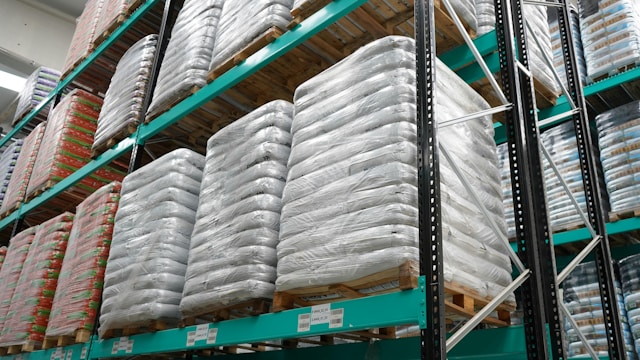
For decades, standardization was the backbone of industrial packaging. Uniform sizes, fixed specifications, and repeatable SKUs made production efficient and predictable. Scale depended on sameness.
That logic is now being tested.
Industrial supply chains have become more fragmented, more climate-exposed, and more behavior-driven. A woven sack that performs well in one region may fail quietly in another. Packaging that looks identical on paper can behave very differently in the field.
The future of industrial packaging is not uniform. It is intelligent.
When Standardization Stops Working
Standardized packaging assumes consistency. Consistent climate. Consistent handling. Consistent storage. In reality, none of these variables are stable.
A sack moving through a dry inland region behaves differently from one exposed to coastal humidity. Manual handling in agricultural supply chains differs from mechanized cement plants. Even stacking habits vary between regions and sites.
When packaging ignores these differences, performance becomes unpredictable. Standardization delivers scale, but not reliability.
Regional Logistics Demand Different Behavior
Packaging does not travel in isolation. It travels through specific environments shaped by geography, infrastructure, and human behavior.
In high-humidity regions, moisture resistance and coating integrity matter more than weight reduction. In areas with heavy manual handling, seam reinforcement and fabric flexibility become critical. In export corridors, stacking stability and abrasion resistance dominate.
Expecting one specification to perform equally across all these contexts is no longer realistic.
Customization as a Performance Tool
Modern customization is not about endless variants. It is about targeted adjustments.
Custom denier distribution allows strength to be concentrated where loads are highest. Coating thickness can be tuned to environmental exposure. Stitch density and seam patterns can be modified to match handling stress.
These changes are subtle, but their impact is structural. They improve fatigue resistance, reduce failure rates, and extend usable life without adding unnecessary material.
Customization, when done intelligently, improves consistency of outcome.
The Role of Data and Feedback Loops
Intelligent packaging evolves through feedback. Field performance data, failure patterns, and handling observations inform the next design iteration.
Instead of treating packaging as a static product, manufacturers can treat it as a learning system. Each deployment generates insight. Each insight refines the next batch.
This approach does not slow production. It sharpens it.
Data-driven customization allows manufacturers to maintain scale while adapting to variability. It replaces guesswork with evidence.
Complexity Is the Wrong Fear
Customization is often resisted because it is seen as complex. More SKUs. More decisions. More risk.
In practice, the opposite is true.
When packaging is tailored to its context, variability in performance decreases. Fewer failures. Fewer exceptions. Fewer emergency fixes. Operational complexity reduces because the system behaves more predictably.
Consistency comes not from sameness, but from suitability.
Scale and Intelligence Can Coexist
Manufacturing scale and customization are no longer opposing forces. Advances in process control, material formulation, and design modeling allow manufacturers to adjust specifications without disrupting throughput.
The goal is not infinite choice. It is informed choice.
Packaging becomes intelligent when it understands where it will be used and how it will be treated.
The Takeaway
One-size-fits-all packaging belongs to a simpler supply chain. Today’s industrial landscape demands awareness, adaptability, and precision.
The future of industrial packaging lies at the intersection of scale and intelligence. Standardization will not disappear, but it will evolve. Uniformity will give way to relevance.
When packaging is designed with context in mind, it stops being generic. It starts being dependable.