
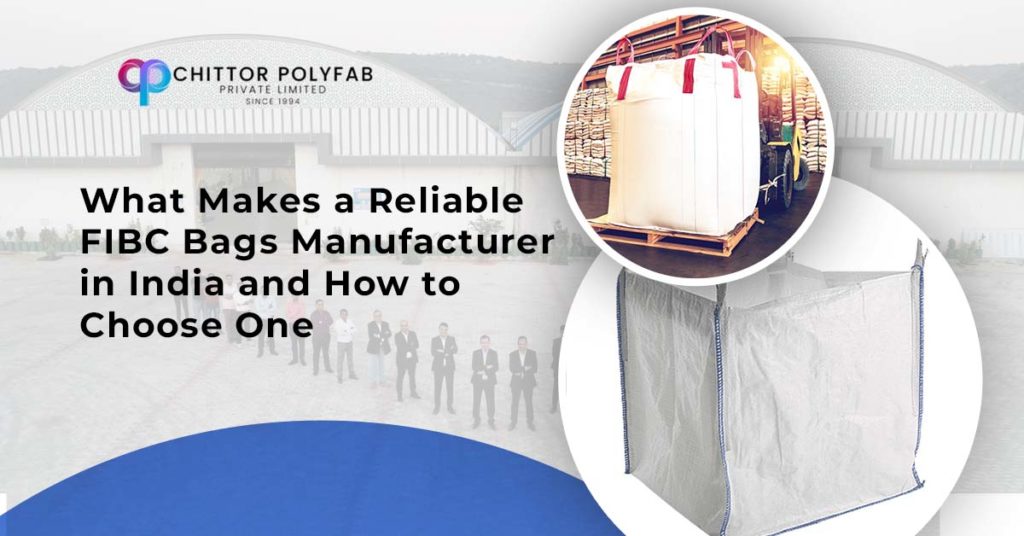
Flexible Intermediate Bulk Containers, often known as jumbo bags, play a central role in transporting bulk materials across industries in India. Selecting the right manufacturer affects operational safety, material handling efficiency and long term product quality. A dependable supplier helps prevent contamination, product loss and delivery delays while supporting a stable supply chain for high volume buyers.
What FIBC Bags Are and Where They Are Used
FIBC bags are woven polypropylene bulk containers designed to store and transport large quantities of dry materials. These bags serve industries such as food processing, construction, chemicals, minerals, agriculture, pharmaceuticals and export oriented manufacturing. Variants include open top bags, spout top bags, baffle shaped bags and lined bags, each suited to specific product types.
What Reliability Means for Bulk Packaging Buyers
For procurement teams, reliability represents more than on time delivery. It covers consistency in tensile strength, seam durability, load capacity, documentation accuracy, testing transparency and clear quality escalation channels. A reliable manufacturer provides stable performance across every production lot and keeps lead times predictable.
Essential Standards and Certifications to Look For
Verified compliance with established standards is one of the strongest indicators of a trustworthy FIBC supplier. Key certifications include ISO 21898 for performance and construction requirements of FIBCs, BIS IS 14738 standards for design and testing, UN certification for hazardous goods transportation, ISO 9001 for quality management and food safety credentials like BRCGS where food ingredients are involved. All certificates should be current and supported by recent third party test reports.
Technical Specifications That Define a Good Manufacturer
- Fabric and yarn quality including GSM accuracy, extrusion stability, UV protection and hygiene grade additives.
- Seam construction with double stitching, reinforced stress points and precise loop integration.
- Safe Working Load and Safety Factor where 5:1 is common for single use bags and 6:1 for multi use models.
- Electrostatic types such as Type A, Type B, grounding dependent Type C and dissipative Type D for flammable or sensitive materials.
Factory Capabilities That Indicate Professional Manufacturing
A dependable supplier maintains adequate installed capacity, modern machinery, trained operators and strict inline inspection at each stage. Reliable factories offer sample or pilot runs, allow design customization, maintain controlled environments for food grade bags and share clear information about subcontracting policies if used.
Quality Assurance and Testing Practices
Strong manufacturers follow documented quality systems with full batch traceability. Common tests include top lift strength, cyclic loading, seam testing, drop testing, UV exposure checks and electrostatic discharge verification. Many buyers prefer periodic third party audits from recognized inspection bodies to ensure consistency. Each lot should carry markings for SWL, Safety Factor, manufacturing date, batch code and electrostatic classification.
Supply Chain Stability and Logistics Support
Reliable FIBC suppliers maintain consistent polypropylene sourcing, predictable lead times and clear packing and containerization standards for domestic and export shipments. Buyers benefit from vendors that maintain buffer stocks, offer transparent delivery schedules and provide complete shipping documentation for international orders.
Customization and Value Added Features
Leading manufacturers support specialized requirements such as inner liners for moisture control, coated fabrics for dust protection, baffle structures for shape retention, QR based tracking, custom printing and tailored filling or discharge spout designs. These add value for industries that require precise handling efficiency.
Commercial Factors to Evaluate
Before finalizing a supplier, examine pricing transparency, clearly stated minimum order quantities, tooling charges, warranty terms, replacement policies and payment structures. Define acceptance criteria for delivered bags and maintain documented agreements on quality and delivery commitments.
Red Flags to Avoid
- Lack of updated test reports or missing third party verification
- Inadequate traceability across production lots
- Large difference between approved samples and bulk production
- Unclear answers about raw material sourcing or capacity
- High advance payment requests without contractual safeguards
How to Choose a Reliable FIBC Manufacturer in India
- Request compliance declarations for ISO 21898 and BIS IS 14738 along with recent test certificates
- Verify factory capacity, QC laboratories and sample production capabilities
- Ask for detailed photos or videos of production and inspection processes
- Conduct third party testing for SWL, seam strength, UV stability and electrostatic class
- Check ISO 9001 and food safety certifications where relevant
- Place a pilot order before committing to large volumes
- Include clear acceptance criteria, warranty terms and corrective action steps in the purchase order
Frequently Asked Questions
Are UN certified FIBC bags required for all applications
UN certified bags are needed only for transporting regulated hazardous materials. For standard materials, compliance with ISO and BIS standards combined with correct Safety Factor is sufficient.
How often should quality testing be done
For critical materials, buyers often request batch wise testing or per shipment inspection. At minimum, manufacturers should provide regular internal testing supported by periodic external audits.
What Safety Factor is suitable for industrial use
The common Safety Factor is 5:1 for single use FIBCs and 6:1 for multi use or heavy duty bags. Buyers must always confirm SWL and testing conditions stated in the certificate.
Final Thoughts
Evaluating a reliable FIBC bags manufacturer in India requires a structured review of certifications, factory capability, material quality, testing transparency and pricing clarity. Buyers who follow a systematic selection process can secure stable supply, reduce risk and ensure safe handling of bulk materials, and partnering with Chittor Polyfab strengthens this process by providing consistent quality and dependable manufacturing expertise.